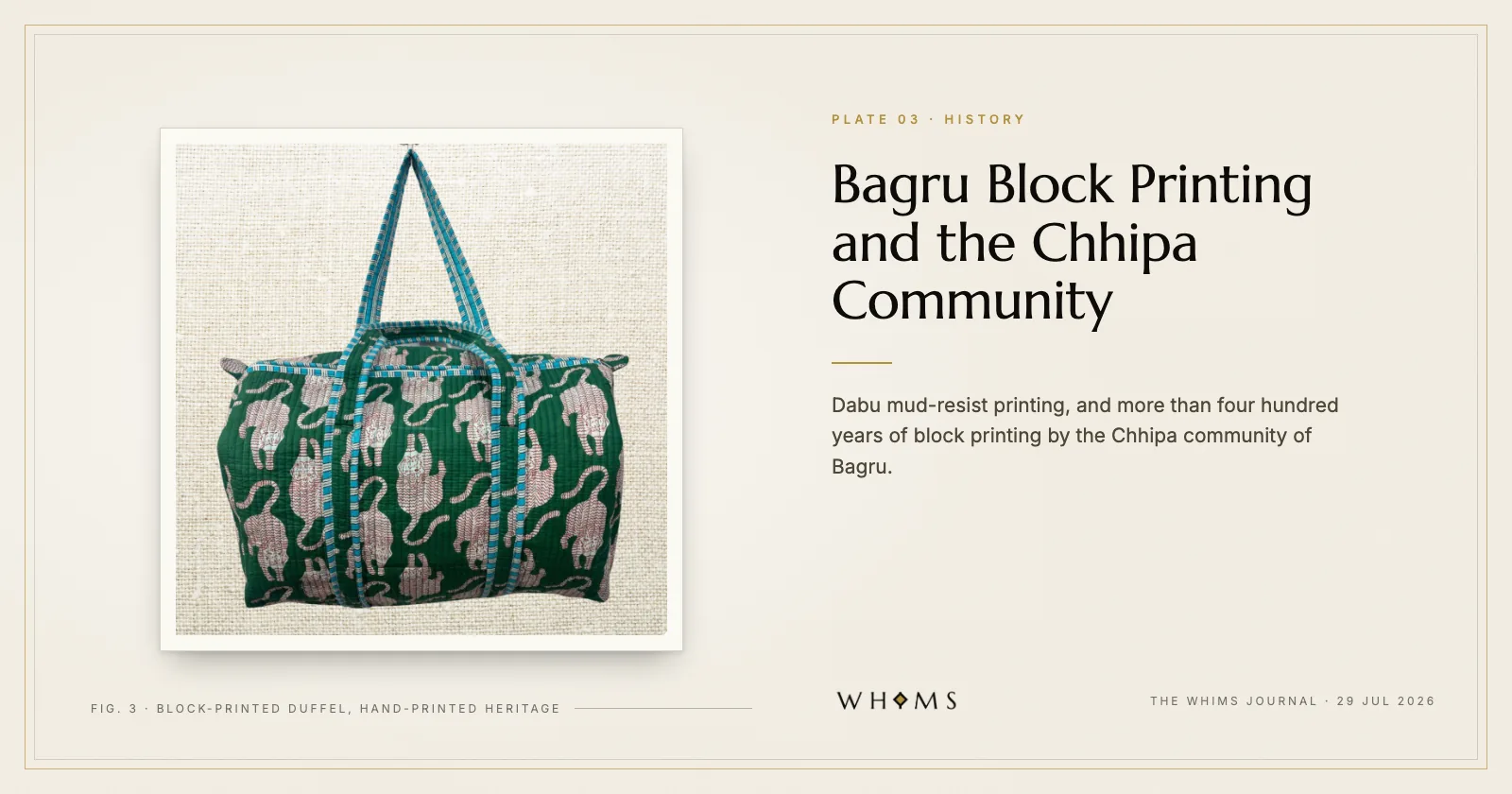

An accident with a muddy dhoti, a river with the right kind of water, and four centuries of secrets kept inside single families.
Every craft has a founding story. Bagru's is unusually specific: a dyer in a village near Akola, Rajasthan, is said to have accidentally packed a mud-speckled garment in with a batch of cloth he was about to dye indigo. Wherever the dried mud clung to the fabric, the indigo simply couldn't reach it. When he washed the mud away, the cloth underneath had stayed its original colour, in the exact shape the mud had covered. The story is placed as far back as the 8th century, and whether or not it happened exactly that way, it captures something true: dabu, the mud-resist printing technique at the heart of Bagru's craft, was discovered by accident and refined on purpose, over more than a thousand years.
The people who turned that discovery into a living craft are the Chippa, whose name is rooted in the word for stamping or printing itself. Roughly four hundred to four hundred and fifty years ago, Chippa families migrated to Bagru from further east in Rajasthan, drawn by something very practical: the soft water of the local river and the clay-rich soil around it, exactly what mud-resist dyeing needs to work well. They settled, and they stayed, and the craft became a family trade passed down rather than taught in any formal sense.
Dabu takes its name from dabaana, "to press," a nod to how the mud paste is applied: pressed onto the fabric with a hand-carved wooden block, one impression at a time. The paste itself is where each family's real signature lives. Built from lime, natural gum, and local clay in proportions no two households share exactly, it's mixed, applied, and then covered in sawdust so it dries without smudging under the desert sun. Only after that does the fabric go into the dye bath, most famously indigo, where the mud-covered areas resist the colour entirely, preserving the fabric's original shade in the exact pattern the block pressed down. When the mud finally washes away, on riverbanks, beaten against stone, the design underneath is revealed for the first time, an inversion of ordinary printing: instead of adding colour, the whole technique works by protecting the cloth from it.
Ask a textile specialist to tell Bagru and Sanganer prints apart at a glance, and the answer usually comes down to mood. Sanganer, a short distance away, is known for delicate floral motifs on a white background. Bagru is the opposite instinct: bold geometric patterns and nature-drawn motifs, the marigold, the rose, the vine, set against cream or richly dyed grounds. Every dye comes from the land itself: indigo for blue, madder root for red, harda for yellow, iron filings worked into solution for black. The printing blocks are carved by a separate specialist community from sheesham or teak, meaning a single finished length of cloth carries the work of at least two different craft lineages before it's ever dyed.
What makes this craft genuinely resistant to imitation isn't secrecy for its own sake, it's that the recipe was never centralised in the first place. Each Chippa family's dabu paste, refined over generations inside one household, respond differently to that day's humidity, that batch's clay, that season's water. Two lengths of cloth printed with the same block, on the same day, in the same workshop, still won't turn out perfectly identical. That's not a flaw in the process. It's the entire point. A machine can replicate a pattern exactly, every time. A Chippa family cannot, and has never tried to, because for four hundred years the value has always been in the version of the pattern that only came out that one time, in that one vat, under that one sky.