
A GI tag is a public record, so it can be checked. Here is what one tells you, what it leaves out, and how to look it up before you repeat it to your own customers.
By WHIMS Editorial · Published · Last updated
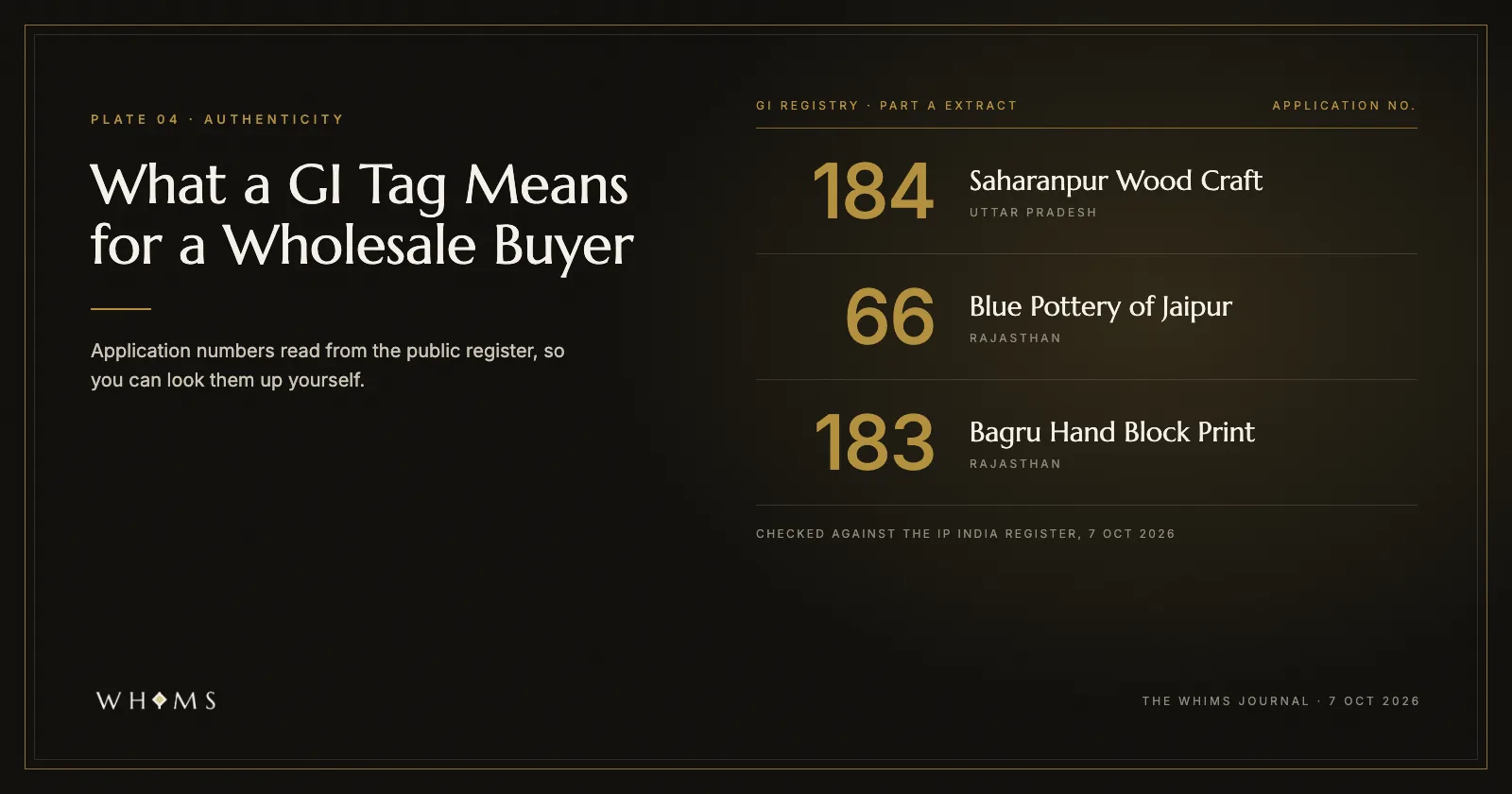
Saharanpur Wood Craft is entry 206 on India's register of Geographical Indications, filed as application 184. Anyone can look that up. That is the whole point of a GI tag, and it is why a registration number tells a buyer more than the word “authentic” ever will.
If you buy handmade decor for a shop, a hotel group or a gifting business, you will see “GI-certified” and “GI-tagged” on a lot of supplier pages. Some of those claims come with a registry number. Many do not. This guide explains what a GI tag legally is, which registrations cover the crafts in the WHIMS collections, and a four-step way to check the registration behind any supplier's claim.
A Geographical Indication is a legal registration that ties the name of a product to the place and community it comes from. In India, GIs are registered under the Geographical Indications of Goods (Registration and Protection) Act, 1999, which came into force on 15 September 2003. The register is kept at the GI Registry in Chennai.
The first batch, registered in 2004 to 2005, included Darjeeling Tea, Pochampalli Ikat and Chanderi Sarees. Handicrafts have been a large part of the register ever since. Each entry carries an application number, which is the number filed with the Registry, and a certificate number, which is the number on the certificate the Registry issued.
It tells you the craft's registered name, the region it is tied to, and that the name is protected under Indian law. It does not grade an individual piece. Finish, weight, glaze consistency and breakage rates still need a sample and an inspection.
| A GI registration confirms | A GI registration does not confirm |
|---|---|
| The registered name of the craft | The quality of a single piece or batch |
| The state or region the craft is tied to | Who made a particular piece or batch |
| That the name is protected under Indian law | Finish, size, packing or delivery terms |
| That a public record exists you can check yourself | Anything about price or minimum order |
In practice the GI is the first filter and the sample is the second. The registration tells you the craft is real and traceable. The sample tells you whether this maker, this batch and this finish meet your standard.
WHIMS works in crafts that hold an Indian GI registration. Epoxy Resin Woodcraft has no registration of its own and is hand-poured resin over Saharanpur sheesham wood, a GI-registered craft.
| WHIMS collection | Registered name | Application no. | Certificate no. | Region | Year |
|---|---|---|---|---|---|
| The Saharanpur Line | Saharanpur Wood Craft | 184 | 206 | Uttar Pradesh | 2014 |
| The Jaipur Blue Collection | Blue Pottery of Jaipur | 66 | 74 | Rajasthan | 2008 |
| Hand-Printed Heritage | Bagru Hand Block Print | 183 | 150 | Rajasthan | 2011 |
Sanganer block printing, the second tradition inside Hand-Printed Heritage, is a separate registration: Sanganeri Hand Block Printing, application 147, registered in 2010. A craft can also have more than one entry. Blue Pottery of Jaipur is listed once as a word registration and again as a logo registration (application 540). When you quote a GI, quote the original word registration.
These numbers were read from the Part A register published on the IP India website, the same list you can use for the steps below.
Ask the supplier for the registered name and application number, then match both against the official register on the IP India website. Check that the state agrees, and keep the number in writing.
The official sources are linked at the end of this page. The Part A list is a PDF, so a quick search for the craft name will take you to its row.
No. A GI registration records the name of a craft and the place it belongs to. The quality of a given piece depends on the maker and the batch, which is why a sample comes before a bulk order.
No. A registration is a record held by the GI Registry. It is not a stamp on each item. Ask your supplier for the registered name and number in writing, and judge each batch from a sample.
Use the registered name and say what the registration covers. Quote the application number as it appears on the register, and avoid implying that the registration certifies quality or a particular maker. Check your own market's labelling rules before printing the claim on packaging.
No. The Epoxy Resin Woodcraft line has no GI registration of its own. Its wood base is GI-tagged Saharanpur wood, and the resin finish is a contemporary technique.
Registry numbers on this page were checked against the official register on 7 October 2026.