
How a city in Uttar Pradesh became one of India's best-known wood‑carving centres.
Saharanpur is not the first place most people would think of for fine woodcraft. It is a city in the north of Uttar Pradesh, and its carving tradition is usually traced to people who moved there and brought their skills with them.
The craft as it is known today, with its deep-relief florals, its lattice work and its vine patterns that seem to grow out of the grain, is usually traced to the Mughal era.
Accounts of the craft say that some carvers from Kashmir settled permanently in Saharanpur roughly four hundred years ago, during the Mughal period. Their designs and skills mixed with local timber, taste and patronage, and the carving that followed is still associated with Kashmiri influence.
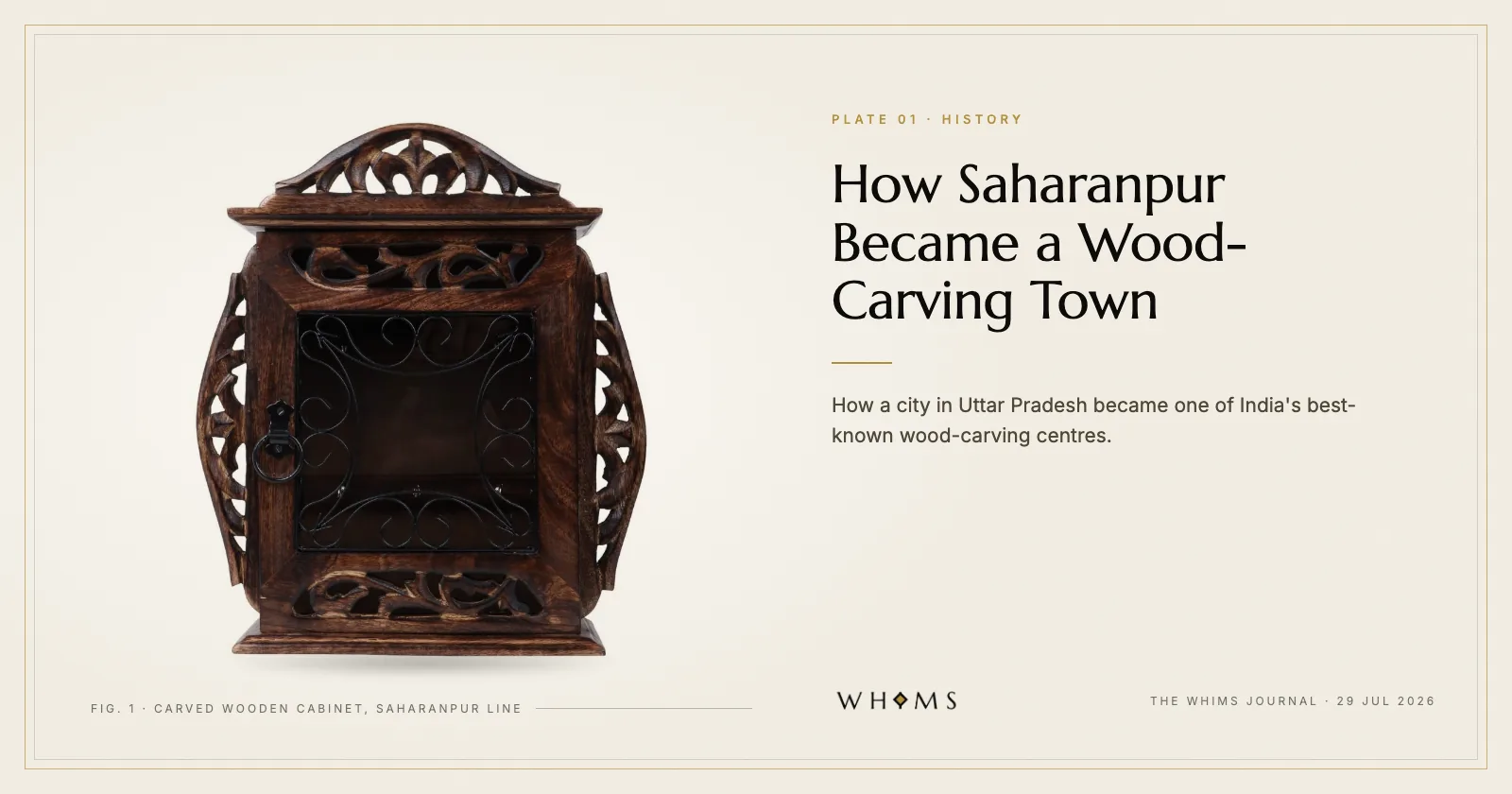
Saharanpur carving is recognisable by a whole visual vocabulary. The registered description of the craft lists floral, foliate and geometric patterns and jaali, the pierced lattice work. Jaali turns a solid wooden panel into a screen of light and shadow, the same principle used in Mughal stone jaali at forts and tombs, translated into wood.
Sheesham, also sold as Indian rosewood, is the wood Saharanpur is best known for, and the town is often called the sheesham wood village. It is a hard, dense timber, and our sheesham guide gives the published figures. The carving itself is done by hand, with chisels, mallets and gouges.
Saharanpur is often described as the largest centre for hand-carved wooden furniture and decor in India, and carved pieces from the town are sold well beyond it.
What the craft rests on is the hand behind the chisel. A machine can rout a repeating pattern in minutes, while hand carving makes a small judgment call at every leaf and curve. That is the inheritance the Saharanpur Line draws on: a wood, a pattern language and roughly four hundred years of carving.
Related reading: Sheesham wood explained, and how it compares with teak, and what a GI tag means for a wholesale buyer.