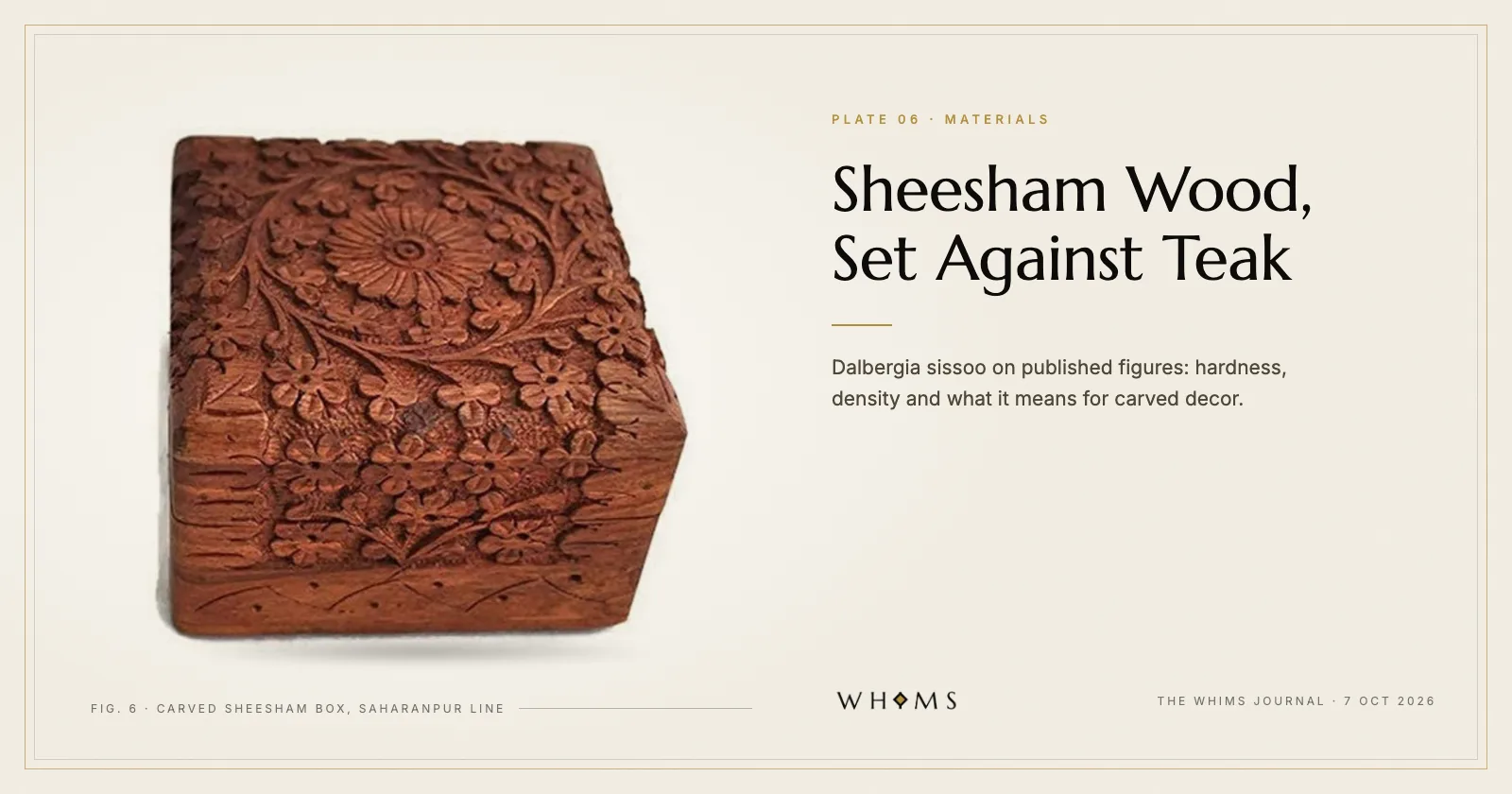

Sheesham is the wood used in the WHIMS Saharanpur Line. Here is what the published data says about it, and how it measures up against teak.
By WHIMS Editorial · Published · Last updated
Sheesham is the wood used in the WHIMS Saharanpur Line. Its botanical name is Dalbergia sissoo, and it is also sold as sissoo and as Indian rosewood. This guide covers what the wood is, how hard and dense it is, and how it compares with teak, using published wood data.
Sheesham is the timber of Dalbergia sissoo, a tree native mainly to northern India, Nepal and Pakistan. It is also sold as sissoo and as Indian rosewood. The Wood Database notes that its status as a true rosewood is disputed.
That is why a clear specification names the species rather than the trade label. If a supplier writes only “rosewood”, ask which species it is.
The heartwood ranges from golden brown to a darker reddish brown. The Wood Database describes the wood as durable to very durable, and notes that sections with interlocked grain can tear out during surfacing. It turns, glues and finishes well.
Sheesham is harder and denser than teak on the published figures. Janka hardness is a standard test of how much force it takes to push a steel ball into the wood, and a higher number means a harder wood.
| Sheesham | Teak | |
|---|---|---|
| Botanical name | Dalbergia sissoo | Tectona grandis |
| Native range | Northern India, Nepal and Pakistan, with wider distribution in Western Asia | Southern Asia, widely grown on plantations in the tropics |
| Heartwood colour | Golden brown to darker reddish brown | Golden or medium brown, darkening with age |
| Janka hardness | 1,660 lbf (7,380 N) | 1,070 lbf (4,740 N) |
| Specific gravity | 0.63 basic, 0.77 at 12% moisture | 0.55 to 0.66 basic |
| Decay resistance | Durable to very durable | Very durable |
| Working notes | Machines well, interlocked grain can tear out, chalky deposits may dull tools | Easy to work, high silica content blunts cutting edges |
| Typical uses | Veneer, plywood, musical instruments, furniture, flooring, boatbuilding, carving, turned objects | Boatbuilding, veneer, furniture, exterior construction, carving, turnings |
On these figures sheesham is roughly 55 percent harder than teak and is the denser of the two woods. Both are listed for carving. For a buyer the practical consequence is weight: denser wood makes a heavier piece, which matters when you plan freight.
Sheesham, sissoo and Indian rosewood are names for Dalbergia sissoo. The Wood Database notes that whether it counts as a true rosewood is disputed, so a product specification is clearer if it names the species as Dalbergia sissoo.
By the Janka test, yes. The Wood Database lists sheesham at 1,660 lbf and teak at 1,070 lbf, which makes sheesham roughly 55 percent harder on that measure.
The Wood Database lists veneer, plywood, musical instruments, furniture, flooring, boatbuilding, carving and turned objects as typical uses.
The Saharanpur Line is hand-carved sheesham wood with brass inlay, made in the craft registered as Saharanpur Wood Craft (GI application 184).
Wood data checked against The Wood Database on 7 October 2026. Figures are published averages, and individual pieces vary.