
Home Collections Wholesale About Journal FAQ Contact Order a Sample
Importing · Buyer's Guide

How to Import Handmade Decor From India: A Step-by-Step Guide for Boutique Buyers

A few registrations, a tariff code for each product and a clean set of documents. Here are the steps in order, with the official sources behind them.

By WHIMS Editorial · Published · Last updated

Importing handmade decor from India comes down to a few registrations, a tariff code for each product and a clean set of documents. A boutique buyer does not need to be a customs expert. You need to know what your country asks for, which code applies to each product and what travels with the shipment.

The rules differ by country and change over time, so this guide sticks to the process and points to the official sources for the details. Where WHIMS terms come into it, they are stated plainly.

At a glance
  • The steps are broadly the same everywhere: register as an importer, classify each product, agree trade terms, prepare documents, clear customs and pay duty and tax.
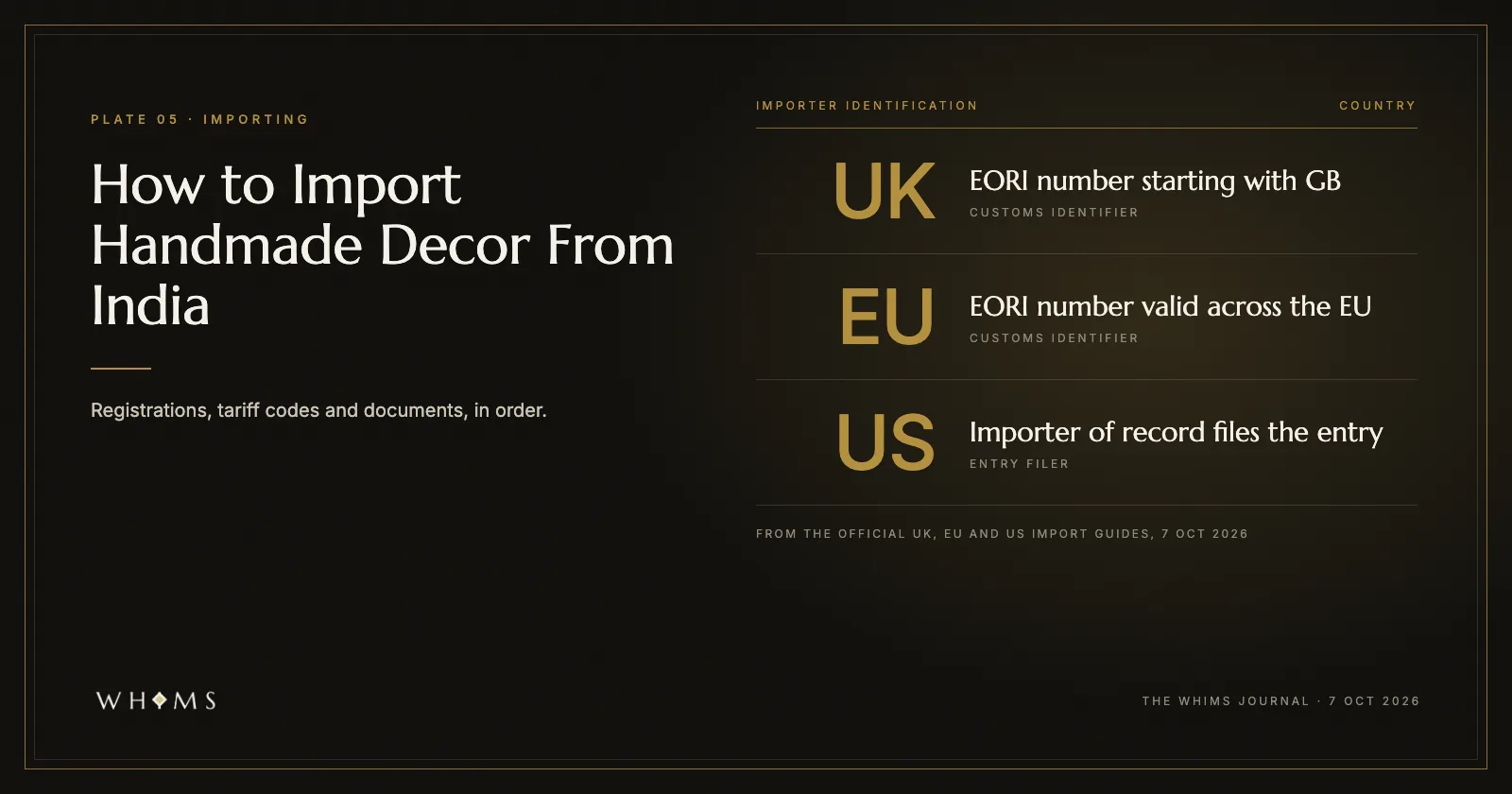
  • UK importers need an EORI number that starts with GB. EU importers need an EORI number valid across the EU.
  • Each product has a tariff code, and in the UK the commodity code decides the duty rate and any licence you need.
  • Duty rates and product rules change, so look up the current rate for your code before you commit to an order.
  • WHIMS bulk orders start at 500 pieces, can be mixed across collections, and begin with a paid sample.

What are the steps to import handmade decor from India?

Decide what and how much you are buying, order a sample, find the tariff code for each product, register as an importer, agree trade terms with your supplier, prepare the shipping documents, then clear customs and pay duty and tax. The order below follows the official import guides for the UK and the EU, with the US customs guide for the US.

  1. Decide the range and the quantity. Decide what you want to stock and how many pieces. At WHIMS, bulk orders start at 500 pieces, and a bulk order can be mixed across the four collections.
  2. Order a paid sample first. A sample shows you finish, size and packing before you commit to a bulk order. At WHIMS every wholesale relationship starts with a paid sample.
  3. Find the tariff code for each product. Every product is classified under a tariff code. The Harmonized System, maintained by the World Customs Organization, supplies the first six digits and is used by more than 200 countries and economies. Countries build their own tariffs on that code. In the UK it is called the commodity code and it sets the duty rate and whether a licence is needed. In the EU you can check the TARIC database.
  4. Register as an importer. A UK importer needs an EORI number that starts with GB. An EU importer needs an EORI number, which is valid across the EU. In the US the importer of record files the entry, and that can be the owner, the purchaser or a licensed customs broker acting for them.
  5. Agree the trade terms in writing. The EU's import guide advises putting the supplier contract in writing with an Incoterms rule, which defines who is liable for what during transport. WHIMS ships on DDP or FOB terms to the US, UK, EU and Australia.
  6. Prepare the shipping documents. For the EU these are an Entry Summary Declaration before the goods arrive, a Single Administrative Document, a commercial invoice, transport documents and, where needed, a certificate of origin. In the UK you keep records of commercial invoices and customs paperwork. In the US the entry documents include the commercial invoice and, where appropriate, a packing list.
  7. Clear customs and pay duty and tax. In the UK you can handle the customs declaration yourself or hire someone to do it. Duty and VAT are worked out from the commodity code and the value of the goods, and a VAT-registered importer can reclaim import VAT using the Import VAT Certificate (C79).
  8. Check product and labelling rules. The EU guide tells importers to check packaging and labelling requirements, and the CE mark where it applies. The US requires goods to be marked with their country of origin unless an exemption applies.

How do the UK, EU and US compare?

The three systems ask for the same kinds of things under different names. This table shows what each official guide names.

UKEUUS
Importer identificationEORI number starting with GBEORI number valid across the EUImporter of record files the entry
Where the tariff code comes fromCommodity codeTARIC databaseUS tariff classification (see the CBP guide)
Documents the guide namesCommercial invoices and customs paperwork kept as recordsEntry Summary Declaration, Single Administrative Document, commercial invoice, transport documentsCommercial invoice and, where appropriate, packing list
Tax noteImport VAT can be reclaimed by VAT-registered importers with the C79 certificateCheck VAT and duty with your national customs authorityCheck duties, taxes and fees with CBP

This is the general process. Duty rates, taxes and product rules depend on the product and on your country, and they change. Confirm them with your customs authority or a licensed customs broker before you order.

Common questions

Do I need to register before my first order?

In most systems, yes. The UK and the EU each ask importers for an EORI number, and the US needs an importer of record on the entry. Check with your customs authority how registration works for your business and apply before your shipment is on its way.

Can I handle the customs declaration myself?

In the UK the government's guidance says you can deal with customs yourself or hire someone to deal with customs and transport the goods for you. Other countries have their own rules, so confirm yours with your customs authority or a licensed customs broker.

Do duty rates stay the same?

No. Each country sets duty rates in its own official tariff, and they can change. Look up the current rate for your tariff code before you place an order, and treat any figure you read elsewhere as out of date until you have checked it.

How do I start with WHIMS?

Message us on WhatsApp. Every wholesale relationship starts with a paid sample, and bulk orders start at 500 pieces, mixed across collections if you like.

Sources

Sources checked on 7 October 2026. WHIMS terms are those stated on this website.

Read next