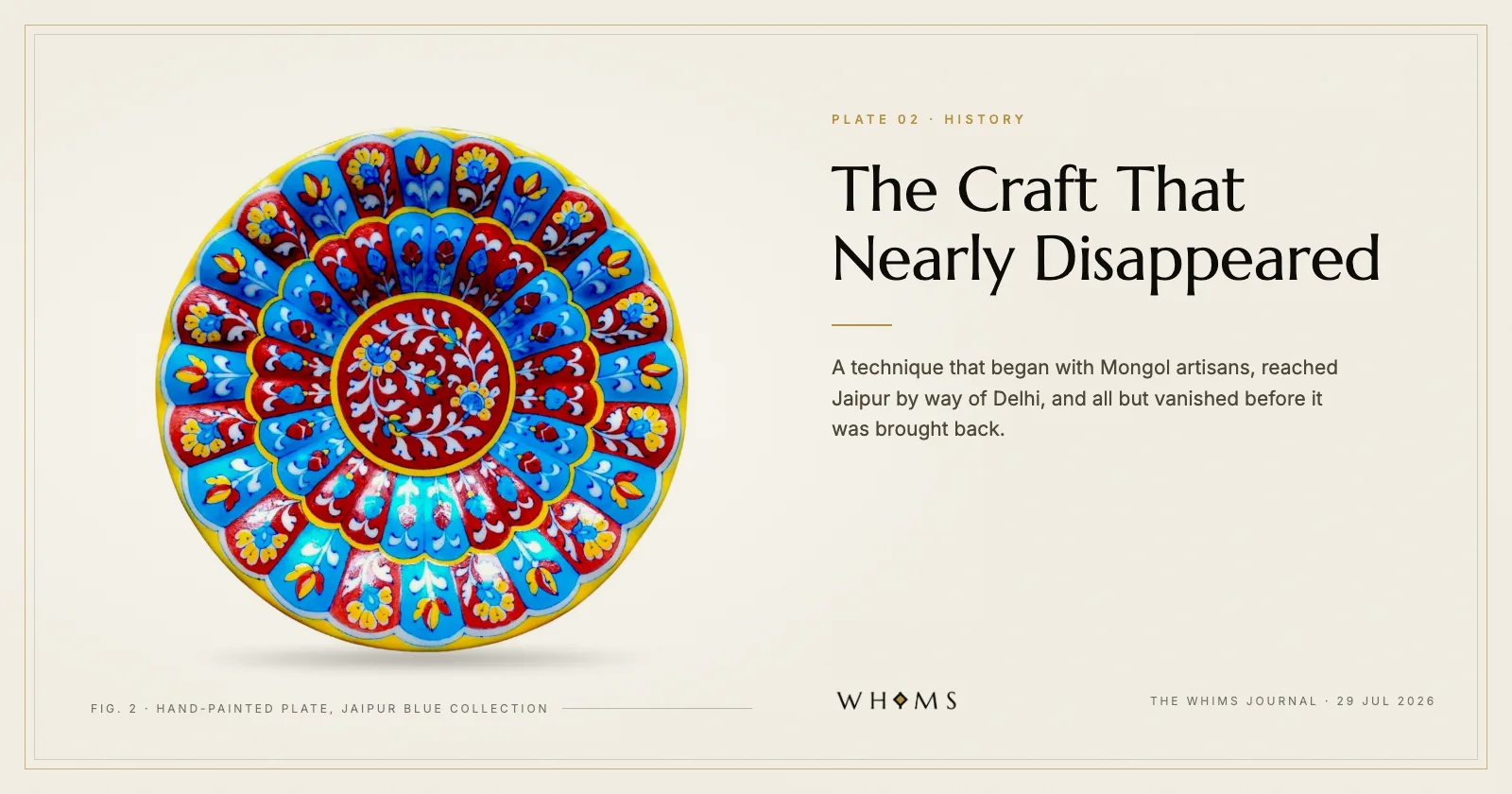

A technique that began with Mongol artisans, reached Jaipur by way of Delhi, and all but vanished before it was brought back.
Jaipur is known as the Pink City, but its most famous pottery isn't pink, it's a deep, unmistakable cobalt blue, and it isn't pottery at all in the way the word usually means. There's no clay in it. And the technique that produces it didn't originate anywhere near Rajasthan.
The glaze technique behind blue pottery began with Mongol artisans, who combined Chinese glazing knowledge with Persian decorative style to create a distinctive cobalt-blue finish. It travelled east to India with the early Turkic conquests of the 14th century, and the Mughals later adopted and expanded it. Accounts differ on exactly when it reached Jaipur: some place it in the 17th century, others in the 19th century, under Maharaja Sawai Ram Singh II.
What makes this pottery genuinely unusual is what it's made from. Instead of clay, artisans work a dough of ground quartz stone, powdered glass, and Multani mitti, or fuller's earth, bound with gum and water. It's closer in spirit to Egyptian faience than to any traditional Indian ceramic. That dough is shaped by hand or pressed into moulds rather than thrown on a wheel, hand-painted with cobalt oxide for blue and copper oxide for green, then glazed and fired exactly once, at a relatively low temperature. There's no second firing to fix a mistake. If something goes wrong in that single pass through the kiln, the piece is gone.
Maharaja Sawai Ram Singh II, who ruled from 1835 to 1880, is credited with strengthening the craft in Jaipur. He is said to have sent local artisans to Delhi to train and brought craftsmen from Delhi to Jaipur, and the craft took its place in the city's royal patronage.
By the 1950s, blue pottery had all but vanished from Jaipur, a centuries-old craft reduced to very few practitioners.
The revival is largely credited to the muralist and painter Kripal Singh Shekhawat, with support from cultural figures including Kamladevi Chattopadhyay and Rajmata Gayatri Devi. What had nearly been lost within living memory is now one of the best-known crafts to come out of Jaipur.
A single firing means there is no second chance to correct a mistake, so every finished piece that comes out of the kiln intact has passed a real test. When WHIMS carries a Jaipur Blue piece, it is carrying a technique with Persian and Chinese roots that all but vanished from Jaipur within living memory.
Related reading: a buyer's guide to Jaipur Blue Pottery, and what a GI tag means for a wholesale buyer, and how to verify one.