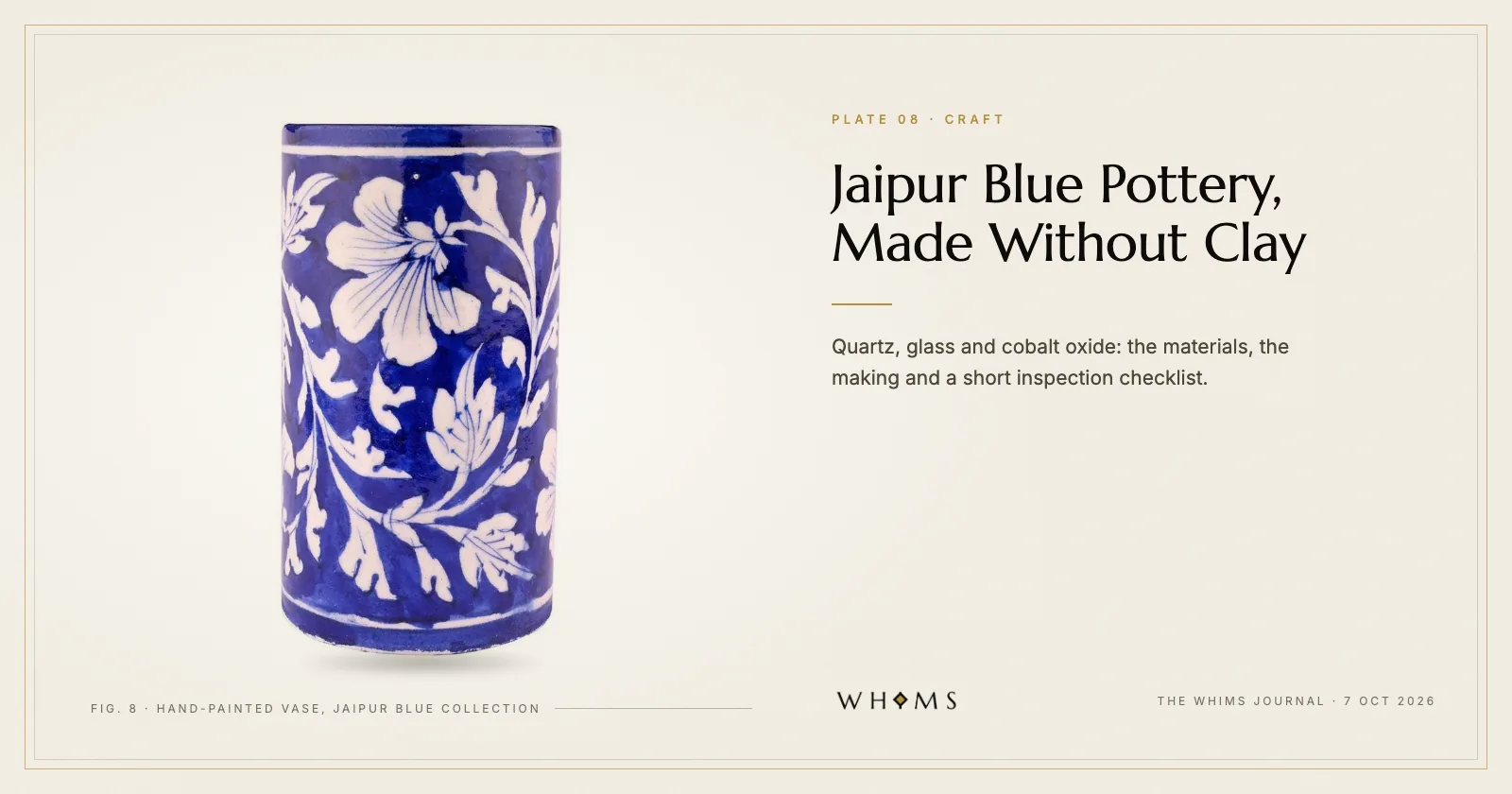

A craft made without clay. Here are the materials, the making and a short checklist for judging a piece in your hands.
By WHIMS Editorial · Published · Last updated
Blue Pottery of Jaipur is made without clay. The body is a dough of quartz stone powder and powdered glass, shaped, hand-painted with cobalt oxide, glazed and fired at a low temperature. This guide explains the materials and the making, and gives buyers a short list of what to look at on a physical piece.
Jaipur Blue Pottery is made from a dough of quartz stone powder, powdered glass, Multani mitti (fuller's earth), borax, gum and water. It contains no clay, which sets it apart from ordinary pottery. Craft documentation describes the material as a frit similar to Egyptian faience.
The documented steps run in this order.
The traditional palette is blue from cobalt oxide, green from copper oxide and white. Contemporary pieces sometimes add colours such as yellow and brown.
These checks suit any hand-painted glazed ware, and they work best on a physical sample, not on photographs.
Because the painting is done by hand, expect small differences from one piece to the next. That variation belongs to the craft.
Blue Pottery of Jaipur is on India's register of Geographical Indications as application 66, certificate 74, registered in 2008 and tied to Rajasthan. The registration records the craft's name and origin. It does not grade an individual piece, which is why the physical checks above still matter. The GI guide in this journal explains how to look up a registration yourself.
No. The body is a dough of quartz stone powder, powdered glass, Multani mitti (fuller's earth), borax, gum and water.
The blue comes from cobalt oxide. Green comes from copper oxide, and the traditional palette also includes white.
It is shaped, painted, glazed and fired in the way pottery is, though the body is made of quartz and glass instead of clay.
No. The motifs are painted by hand, so small differences from one piece to the next are normal. A sample lets you see that for yourself before you order.
Craft facts checked against the sources above on 7 October 2026. Descriptions of the process vary slightly between workshops.