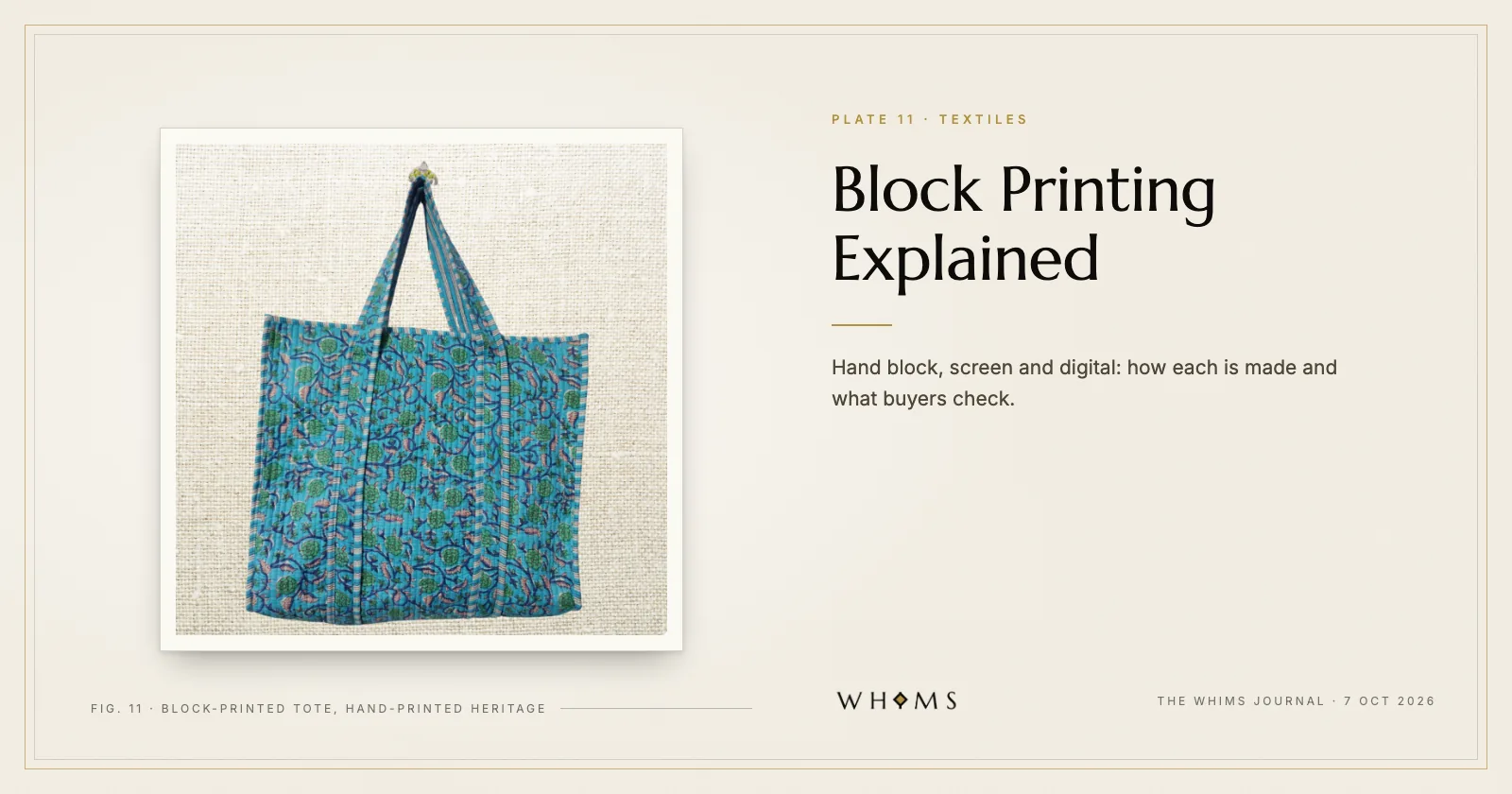

Three ways of printing cloth that can look alike from a distance. Here is how each one works and what buyers check.
By WHIMS Editorial · Published · Last updated
Block printing is a way of printing cloth by stamping it with carved wooden blocks. Screen printing and digital printing can look similar from a distance and are made very differently. This guide explains the three methods and the signs buyers often check when judging a printed textile.
Hand block printing prints a pattern onto cloth by pressing carved wooden blocks onto it by hand. In India the technique is mainly associated with the north and west of the country, according to the Victoria and Albert Museum. The V&A describes carving the blocks as a highly skilled practice, and notes that a small repeating pattern in several colours needs multiple blocks.
Dyes matter to the look. The V&A notes that indigo has been used for millennia in most regions of India to colour yarn and fabric, and that it takes expertise to prepare and use.
Screen printing applies ink through a mesh-based stencil. A squeegee moves across the screen and pushes ink through the open areas onto the fabric. Digital textile printing is an inkjet-based method of printing colour onto fabric, so the design goes on directly without blocks or screens.
| Method | How the design goes on | What the repeat tends to look like |
|---|---|---|
| Hand block printing | Carved wooden blocks are pressed onto the cloth by hand | Small differences in alignment between impressions are common |
| Screen printing | Ink is pushed through a mesh stencil with a squeegee | Very regular repeats |
| Digital printing | An inkjet printer prints the design onto the fabric | Very regular repeats |
Textile makers commonly point to two signs. Neither is conclusive on its own, so treat them as prompts for questions and not as proof.
The most reliable check is to ask the supplier in writing how a piece was printed, and to judge the finish on a physical sample.
Two block-printing crafts from Rajasthan are on India's register of Geographical Indications: Bagru Hand Block Print (application 183, certificate 150, registered 2011) and Sanganeri Hand Block Printing (application 147, registered 2010). A registration records the name and origin of a craft. Our GI guide explains how to look one up, and our history post tells the story of Bagru printing.
WHIMS Hand-Printed Heritage textiles are printed by hand with wooden blocks, using natural dyes.
No. Block printing stamps colour onto cloth with carved wooden blocks. Screen printing pushes ink through a mesh stencil with a squeegee.
Each impression is stamped by hand, so small differences in alignment from one repeat to the next are expected. That variation is one of the signs textile makers often point to.
It can. Natural dyes such as indigo have been used in India for thousands of years, according to the V&A, and the dyes used vary by workshop. WHIMS Hand-Printed Heritage textiles use natural dyes.
Two are registered for Rajasthan: Bagru Hand Block Print (application 183, certificate 150, 2011) and Sanganeri Hand Block Printing (application 147, 2010). A registration records a craft's name and origin, not the method used on each individual piece.
Checked on 7 October 2026. The two visual signs are commonly cited by textile makers, are not a formal test, and vary with the fabric and dyes.