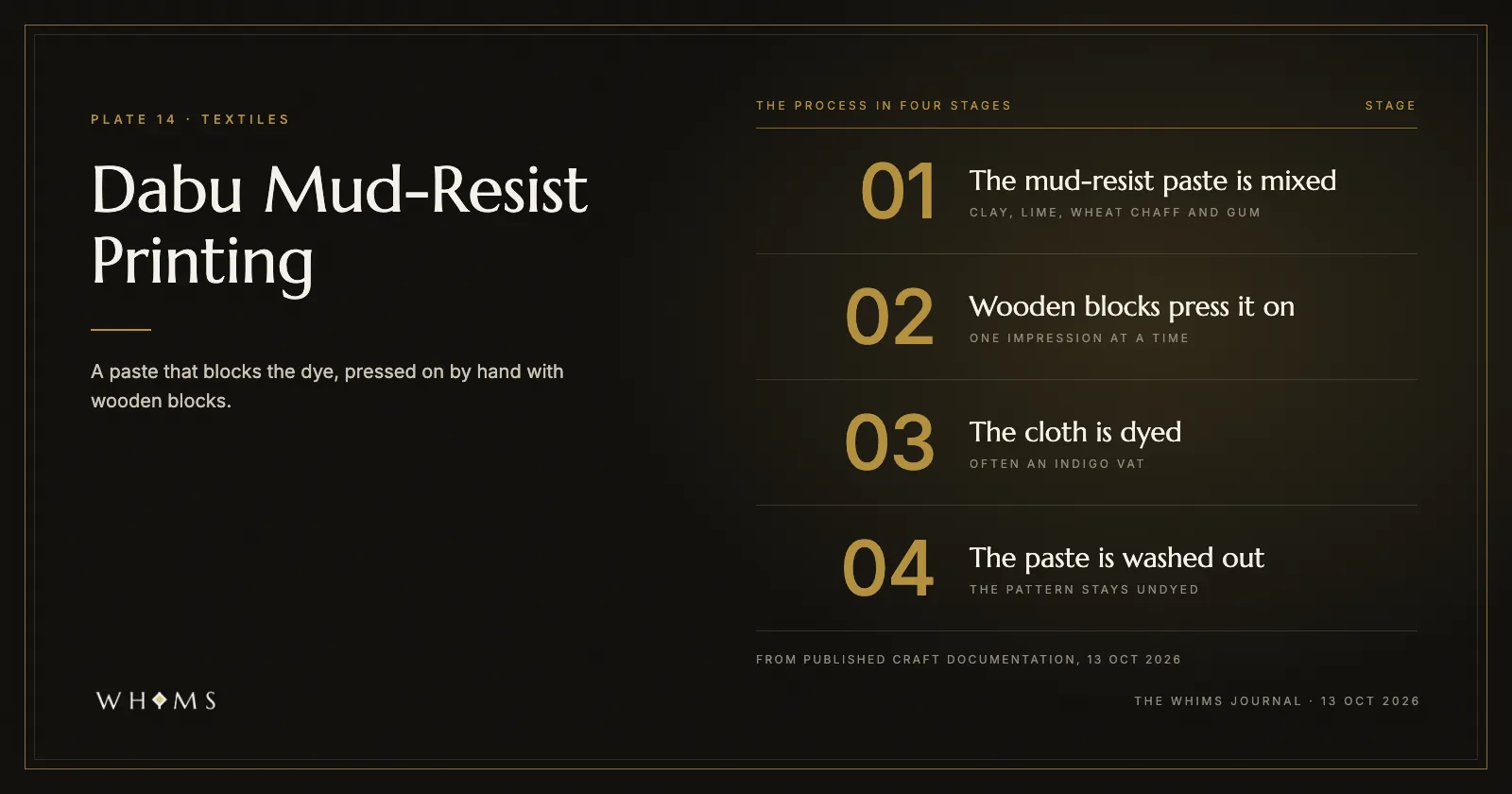

A paste that blocks the dye, pressed on by hand with wooden blocks. Here are the steps, and why every one of them takes time.
By WHIMS Editorial · Published · Last updated
Dabu is a mud-resist printing technique from Rajasthan. A paste of clay, lime, gum and wheat chaff is pressed onto cloth with carved wooden blocks, the cloth is dyed, and the pasted areas keep their original colour. This guide explains the steps and why the process cannot be hurried.
Dabu is a form of mud-resist block printing. Instead of printing a colour onto the cloth, the printer prints a paste that blocks the dye. Where the paste sits, the cloth stays its original colour, and where it does not, the cloth takes up the dye. The pattern is the shape the paste leaves behind.
The steps below follow the documented process. Details differ between workshops.
Each stage waits on the one before it. The paste has to dry in the sun before the cloth can be dyed. Deeper colour comes from repeated dips with time in the air between them. The paste then has to be soaked and washed away. One source describes the whole process as demanding physical effort at many stages.
Dabu is practised mainly in Rajasthan. Sources name Bagru near Jaipur, Akola in Chittorgarh district, Sanganer and Pipar City near Jodhpur. Bagru Hand Block Print is a registered Geographical Indication (application 183, registered 2011). A registration records a craft's name and origin, so it does not describe how an individual piece was made. Our GI guide explains how to look one up, and our history post tells the story of Bagru printing.
Ask the supplier in writing how a piece was made: whether the resist was printed by hand with blocks, which dye was used and whether the piece is a dabu print or a different technique. Then judge the result on a physical sample. Our block printing guide lists the signs buyers often look at.
Dabu is a mud-resist printing technique. A paste is pressed onto cloth with carved wooden blocks, the cloth is dyed, and the pasted areas stay undyed.
Dabu is one kind of block printing. The difference is that the blocks print a resist paste and not a dye, so the pattern appears where the dye could not reach.
Sources describe a paste of clay, lime, wheat chaff and gum, with sawdust sprinkled on the wet paste to stop it smudging. Recipes vary between workshops.
Indigo is the dye most often described, because the resist works well in an indigo bath. Ask the supplier which dyes were used on a particular piece.
Checked on 13 October 2026. Descriptions of the process vary slightly between sources and workshops.